Google
 

Tuesday, October 30, 2007

Building Aerial Strategy Platform: China's Future Airlifter to be assembled in Xi'an

In August, news from COSTIND website showed that Zhang Yunchuan, minister of COSTIND(Commission of Science Technology and Industry for National Defense), recently visited Xi'an Aircraft Industry Group for inspecting the proceeding of Heavy Airlift Assembly Line Construction. His visit indicated that the Final Assembly Line of PLA future Heavy Airlift has been obtained by Xi'an Aircraft Industry Group, which is the manufacturer of well-known JH-7A attack fighter.

China's aspiration for large Air Transporter is pursued in both ways of military and civilian uses. The civilian aircraft, is to satisfy the boom of China's future civilian air transportation. Provinces with Aviation Industries, such as Shanghai, Shanxi, Tianjin, Sichuan,etc, all aim the Large Jet Plane or Heavy Airlift as a great opportunity to upgrade their industrial and economic system. ACAC(AVIC I Commercial Aircraft Company), based in Shanghai, became the developer and manufacturer of ARJ21, a 70-80 seats class regional Jet. ARJ21 is seen as China's first step in 100 ton class civilian aircraft. And in 2006, An A-320 final assembly line project was introduced in Tianjin.

Being an inland military Aircraft and Electronic Industries base, Shanxi had been in embarrassed position since Tianjin and Shanghai's rising in aircraft manufacturing. Shangxi local authority even urged "Input Provincial Power to get the project of Heavy Transport Aircraft". Now Shanxi is seemed to realize its final goal. ShanXi province and Xi'an city will use this occasion to speed the military industrial base development in Western area of China inland.

The military heavy airlift is defined by administration as "National Significant Project", not as usual "National Key Project". In fact some Chinese resources showed that China central government has counted military airlifter as a future strategic military system and a crucial decision for fully waking China's Aviation Industries in next decade.

In his visit, Minister Zhang urged that the R&D on Heavy Airlifter should be based on the mature and reliable technologies, but its performance can approach the international advanced transport aircraft with Chinese independent innovative technologies. From his words, it can be summarized that China's future Military Heavy Airlifter Prototype will be designed on Russia's IL-76MD. But China's airlift aircraft will has an expanded size and payload capacity, and then equipped with 4 high-Bypass ratio turbofan engines (from FWS-10), improved electronic devices.

In general, PLA's next generation lifter will exceed Russia's IL-76 and Japan SDF's being developed C-X transport aircraft and be close up to the "Globalmaster III". PLA’s Heavy Lifter’s Possible Specifications can be described as below:
Crew: 3
Payload Capacity: 60,000-65000 kg
Length: 49 m
Wingspan: 50 m
Height: 15 m
Wing area: 310 m2
Empty weight: 100,000 kg
Max takeoff weight: 220,000 kg
Power: 4× Chinese-made High-bypass turbofans
Maximum speed: 750-800 km/h
Range: (with max payload) 4,400 km
Service ceiling: 13,000 m

For years, Xi'an Aircraft Industry Group has been absorbing foreign aviation technologies and QC(Quality Control) & QA(Quality assurance) measurements by industrial subcontracting with Boeing and Airbus. Meanwhile, AVIC I is preparing the correspondent attached technological projects. Such as CARDC (China Aerodynamics Research & Development Center) has achieved breakthrough in "Turbofan Engine low-speed Simulating Testing Technologies" for Airlifter high bypass engine. Besides, in 2008 China's research on Polyacrylonitrile (PAN) based carbon fibers will reach its milestone to produce high-performance aviation materials. PLA's future heavy airlifter will realize the shrunk aircraft empty weight by CF Compound Material made fuselage and wings.

The strategic value of China's Heavy Airlifter, is not only the great improvement PLA's forces long distance projection, but also an air platform for China's New concept Strategic Weapon System. A great conventional weapon gap between PLA and U.S. forces usually shrivels China leaders’ purpose of taking Taiwan back by forces. So Heads in China Government has been focusing on unconventional "Shashoujian" weapon system for strategic striking back.

Now PLA is very interested to Boeing ABL project and FALCON Small Launch Vehicle. Resources in PLA unleashed that the future heavy transportation aircraft will play as important air platform in fighting against with U.S. advanced stealth fighter and cruise missiles. It can be speculated that High-power microwave weapon and some kind of directed energy weapon will be installed on aircraft to jam and destroy air objects, like F-22, F-35 or Tactical Tomahawk.. Base on technological obstacle, Chinese air platform can not use COIL laser for anti-ballistic missile but will have compact laser self-defense system to defend enemy air-to-air missiles.

Like FALCON program tested on U.S. Air Force C-17, China's transport aircraft will become a rocket or ballistic missile aerial launching platform. China has demonstrated its air-launched ballistic missile in 2006 Zhuhai Airshow. In a possible conflict with U.S. in west pacific, PLA will have more striking options by strategic aerial platform, such as anti-craft carrier ballistic missile or anti-satellite space weapon.

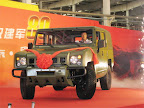
PLA will buy 2100 BJ2022JC Light Utility Vehicles

this article once published on JDW

August 2rd, Beijing Automobile Works (BAW) announced that PLA will purchase 2100 BJ2022JC “Brave Warrior” light utility vehicles for the troops. Resources said that the 1000 vehicles will provided to Fujian sub military district where the frontline of Taiwan Strait is.

BJ2022JC is the successor of classic “BJ212” light wheeled vehicle (a Chinese copy of the Soviet UAZ469B), which has been used in PLA for over 40 years. In 1999, PLA invited a public bidding for its generation utility vehicle in China automobile manufactures. After 3 contends, “Brave Warrior” beat other competitors and won the final bid


BJ2022JC series has 0.5 ton class and 0.75 ton class chassis for providing a wide using role in battlefield commanding, materials transportation, personnel carrier, communication and ground assaulting (with light weapons).

BJ2022JC is a full- time 4WD vehicle, which has HMMWV-kind differentials for both and rear to power the wheels. And its independence suspension system learned from Land Rover for greatly improved control in off-road conditions.

The Engine, a 3.2L turbo-charged inter-cooling diesel engine, has output 101.5 KW at 3600 RPM and can reach the biggest torque 313 N·m at 2000 RPM. This diesel engine also has an excellent performance in low temperature. The vehicle can be initiated and run in 20 seconds when lowering than -30, and by some assistant measures, the engine can be operated in 45 seconds when in condition between -30and -45.

“Brave Warrior” has a creative design: dual-fuel-tank. The main tank has capacity of 85L and the back-up tank’s capacity is 18L. The fuel feeding can be easily manually switched from different tanks. BAW claims that the engine fuel efficiency is average 6L /(100 km) and BJ2022JC can reach max range over 1000KM. But some resources from users said that the engine fuel economy is very hard to be complimented.

In the research of the vehicle, BJ2022JC passed the endurance testing in Hei Longjiang Province (High latitude area), Yunnan Province (hot-humidity area), Gansu Province (Desert area) and Tibet (High altitude area). The vehicle was also actualized in an air-drop test for Air-borne performance evaluation. The total test driving range is over 350000 km.

Actually, BJ2022JC is manufactured in the Shunyi District factory owned by Beijing Benz-Daimler Chrysler Automobile Co,Ltd, which was once the Beijing Jeep Automobile (a BAW- Chrysler company) and now is a joint-venture by BAW and Daimler-Chrysler. And BAW also acknowledged that most technologies in BJ2022JC are from BAW’s over 20 year cooperation with western automobile manufactures.

Tuesday, August 7, 2007

PLA unknown Wheeled Reconnaissance Armor Vehicle emerged


July 29, when Type 92 ICV and PTL02 100mm Wheeled Assault Gun entered Russian territory for "Peace Mission 2007" Joint Exercise, an unknown PLA wheeled Reconnaissance Armor Vehicle (WRV), based on WZ551 chassis, appeared in analyzers' horizon. At present, the WZ551 armored vehicle chassis has been developed a huge family, which includes the variants like ICV, APC, assault gun, anti-aircraft artillery gun, armored recovery vehicle, artillery reconnaissance vehicle and armored reconnaissance vehicle.

According to resources, the new WRVs are equipped into the Reconnaissance Battalion directly under the 80-year-history 127th light mechanized Infantry division, 54th Group Army. 127th and 162nd mechanized divisions, are both appointed as the strategic mobile troops.

In 2005, 127th division took part in the "Peace mission 2005" Sino-Russia joint exercise. And 162nd Division played the well-known "Queshan 2006" war game in last year.
From the unleashed photos, the WRV has been found 2 kinds of Reconnaissance instruments. One is the integrated optical system which incorporates Infrared imager, day TV, laser designator, laser rangefinder, by which operators can monitor the battlefield information in the vehicle without exposing.

The outside air condition system showed that lots of electronic devices installed inside the vehicle. It is very interesting that there is a primary FBCB2-like system in the MRV to enhance commander's battlefield situation awareness. So the system mounted on a extendable mast would be a communication platform to transmitting signal via ground wireless network. Another possibility is a radio signal surveillance system, which probably has the ability to wiretap or jam counterpart battlefield communication.


Years before, China has developed a Reconnaissance Armor Vehicle from the WZ523 armored vehicle chassis, which however did not enter service. And in a previous TV report, the armored commanding vehicle in 127th division showed ability to fly and operate ASN-15 mini UAV for ground surveillance.

Under the influence of U.S Stryker family, PLA is speeding its upgrades on the C4I systems in light mechanized troops to improve the joint combat warfare in future possible battle in Taiwan where is not appropriate for Heavy mechanized group army.

Monday, July 30, 2007

Electronic Border Shield being built in China

PLA Border Patrol Troops is building an advanced Integrated Border Surveillance System--"Border Information Integration System", which is now displayed in the 80th anniversary Exhibition in Beijing.


(user interface of BIIS)
The borderline of People's Republic of China, maybe the longest in the world and in the most complex geopolitical area. Even the huge PLA border troops, still can not deal with the numerous illegal aliens, drug pushers and even the penetrating Xinjiang minority armed anti-government militants. For those reason, China had been initial to research Chinese edition "America's Shield Initiative"(ASI)--BIIS since 2002 for getting a improved border monitoring.

The technological foundation of BIIS, is the national scale communication fiber network considerably invested by PLA. This network brings a possibility of building BIIS. Now the BIIS is distributed on Military district--sub district--border regiment three levels.


(Surveillance Cam on border)


The first user of BIIS is Xinjiang Military Zone which is under the Lanzhou Combat District. The reason is simple that Xinjiang Autonomous District is the area where PLA has the heaviest patrol duties for the longest borderline sharing with several countries. The demonstrated system in the exhibition showed that the BIIS is a kind of platform integrated with information management, remote sensing, electronic warning, cam monitoring, satellite positioning and patrolling unit monitoring.

Along the borderline, microwave warning and High-voltage pulse warning system are installed. When inducting illegal intruders, the warning signal will be transferred to backward station to highlight the related location. And inland staff will switch the correspondent cam to watch the activities in sensitive directions.


(Position Displaying of BIIS)


Satellite positioning technology is also applied in BIIS to monitor the frontline patrol units. By China's "Compass-1" Guidance constellation, the system can display the real-time location and patrolling routing line of active people and vehicles.


(Message Sending Interface)

The operation system of BIIS also provides multi-ways of information sharing, including sending information to the "Compass-1" terminals used by patrolling units, mobile phone Short messages and intranet messenger


(BIIS used for marine near Fujian Province)


At present, the BIIS system has covered several military districts in Xinjiang, inner Mongolia and Yunnan province, where the most of China's land border are. Furthermore, BIIS is operational in marine near Fujian Province. In Tibet, China has not built such kind of system, because the rigorous condition there is a great challenge to modern surveillance technologies, fortunately, same to foreign intruders.

Technically, China's BIIS is lacking of infrared/night vision surveillance system to guarding active objects and is not multiplex in electronic detecting methods. In different commanding levels, the information integration is needed to be improved, because the commanding headquarter in levels can not simultaneously receive the monitoring information when facing the emergence accidents.

Systemically, the hermetic of PLA makes a truth that the BIIS is based on an exclusive computer network, the result is that BIIS has no possibility to share information with civilian public organizations, like local authorities, police departments and customs.

In coming future, China certainly will use new technologies to enhance the performance of BIIS. If the border troops can be separated from PLA system and open the BIIS network, China will have a brighter future to construct a revolutionary border surveillance system.