China's Z-11 Armed helicopter (Z-11W), which is a Copy of AS350 Helicopter and jointly produced by Changhe Aircraft Corporation (CAC) and China Helicopter Design and Research Institute, has successfully passed the technological pre-qualification on August 31. The website of COSTIND released this piece of news on September 4.

Z-11W helicopter is a variant of Z-11 2-ton class light Utility Helicopter which is usually believed to be a Chinese "pirate" of French AS350 "écureuil (Squirrel)". Since the Birth of Z-11 in 1994, it has been facing a converging attack from domestic and international Markets.
Actually, PLA army needs light Utility helicopter but not the early inferior Z-11, which can not catch up its original French model born 20 years ago. So Z-11W is modified from an enhanced Z-11MB1 platform powered with ARRIEL 2B1A engine and is equipped with systems for air assaulting, like fire control system, V/UHF frequency-hopping radio and improved VEMD (Vehicle and Engine Multi-function Display) avionics. Besides, CAC once announced that Z-11W armed helicopter can carry 4 HJ-8 anti-tank missile and rocket launching pods.
And in overseas market, Z-11 is still in constraint for its indigenously copy design without any license from Eurocopter. It makes a truth that Z-11's exportation was indeed in embarrassing position for searching steady-going clients.
From 2005, CAC has been contacting foreign countries for Z-11's selling. November 22-23 2005, Argentina Air force 3-member delegation once visited CAC for consulting Z-11's exportation and building localized assembly line.
But resources said that the project was frozen under the pressure from Eurocopter. But CAC did dot abandon this opportunity and recently organized a Z-11MB1 helicopter flight demonstration on June 10 2007 in Argentina for its Air Force.
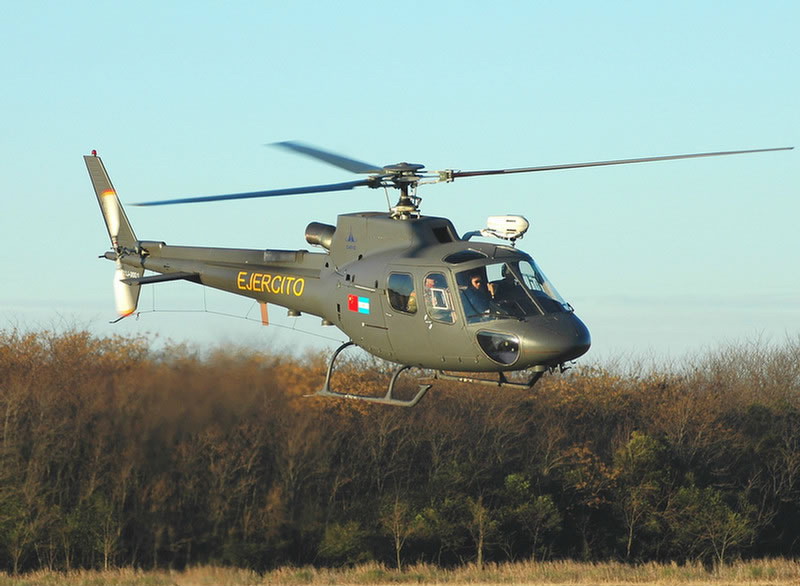
Photographed by Juan Carlos Cicalesi
And Z-11W's passing qualification showed that CAC is speeding in looking for domestic or international buyers for its Z-11 families. And CAC hope that Z-11W can win PLA army's appreciation to play reconnaissance role like OH-58D for ground forces and attract potential foreign buyers from third-world developing countries.
When Z-11W passed the qualification, resources from Philippine in September says that its Air force will spend 460 million RMB to replace its Vietnam-war-time copters from 8 multi-function helicopters from China. Although the exact model is unclear, but the unit price tells that it is probably Z-9, which is manufactured from HAC (Ha'erbin Aircraft Corporation).
August 28 Chinese AVIC I in Beijing announced to establish SAC Civilian Aircraft LTD and CAC Civilian Aircraft LTD.SAC Civilian Aircraft LTD is located in Shenyang and jointly ventured 500 million RMB by SAC (40%), XAIC (45%) and CATIC IC (15%). While CAC Civilian Aircraft LTD is registered in Chengdu and invested with 500 million RMB by CAC and other same two investing parties in identical contribution.
SAC (Shenyang Aircraft Corporation) and CAC (Chengdu Aircraft Corporation) are the most powerful manufactures of military fixed wing aircraft, such as J-10 and J-11 fighter.
AVIC I's action in civilian manufacturing area indicated that Chinese aviation industries are drastically abandoning its previous planned economic operation mode in military system production. Since 1980s, SAC and CAC have been producing aviation components under sub-contract with western aircraft manufactures like Boeing and Air Bus. What ever SAC or CAC, has tasted the sweet in oversea cooperation and hope to gain bigger part in the big cake of China future aviation market.
After market research, AVIC I believed that in next decade China's domestic air transportation will boom over 4 times and need other 1600 airliners, which presume 150-180 billion US$ market, only next to U.S.; and in 2050 China will be supposed to demand 3000 jetliners and freights, which valued to about 350-400 billion US$.
XAIC (XI'AN AIRCRAFT INTERNATIONAL CORPORATION SZSE:000768) is the first public listed enterprise initiated by XAC (Xi'an Aircraft Corporation) in 1997. XAIC is a foregoer in Chinese aviation Industry to extend civilian production in a separated firm.
Under China's rules of aviation products exportation, SAC, CAC or XAC has no permission to direct provide products to foreign buyer but via the CATIC (China National Aero-Technology Import & Export Corporation). CATIC IC (CATIC Investment Co,) is a subsidiary of CATIC to deal with investment and management consulting. The involvement of CATIC IC proves that the CATIC's influence in aviation products & technology import and export.
The merge of new entities implied that AVIC I still can not fully integrate its all commercial productive capacity just because of the contention between SAC and CAC. Resources showed that these two giants are stealthily running in PLA General Armament Department and Administration for capturing China's next generation fighter.
In civilian range, SAC and CAC are both in confrontation without any fallback. In the birth of new JVs, SAC unleashed that it has signed contract with one of Top Utility Aircraft Manufactures to produce sport aircraft. And 2 weeks ago CAC has already built up an “Aerospace Hi-Tech Industrial Zone” in Chengdu for transferring advanced Aeronautical technologies to civil field.
Further, manufacturers in China are apt to trade with foreign corps and cast off CATIC's manipulation and taking percentage of deals. But it is still unrealistic in exist system. The newly founded set-ups can be deemed as a compromise among different sides in AVIC I.
On Monday August 27, General Jing Zhiyuan, Commander of PLA Second Artillery Corps, reaffirmed "China's policy of 'no first use' nuclear weapons will be persistent and never be changed", when he met U.S. Rep. Ike Skelton, who is the Chairman of the House Armed Services Committee.
Ike Skelton headed a seven-member delegation of US lawmakers to visit Headquarter of Second Artillery Corps in Beijing. The delegation is the first batch of us congressmen to visit the second artillery force.
During his visiting, Gen. Jing briefed China's nuclear policy & strategy, Nuclear Weapon Commanding system and the construction and application of nuclear forces.
"China and United States are constructive partners and 'stakeholders' in global world." Gen. Jing said, "At present, China holds a positive attitude toward the ties between two armed forces, and is willing to make joint efforts with the US side to push forward exchanges and cooperation."
Rep. Ike Skelton believed that both armed forces should strengthen the dialogues and exchanges for boosting friendship and peace between two countries.
China's policy of "no first use of nuclear weapons on non-nuclear countries and zones at any time under any circumstances" was stated in 1960s. In fact, PRC was the first to pledge no-first-use of nuclear weapons for possessing a minimal deterrent.
Under the context of China's rising, other great powers and western countries are always wondering whether China will alter its policy on nuclear weapon using. Although China has been announcing a unshakable adherence on "no first use" in several "White Papers", the aggressive officers are doubting the validity of Chinese previous nuclear policy designed by Mao Zedong and Zhou Enlai.
Most of hawkish shade is from PLA academic organizations but not commanding officers like Jing Zhinyuan. Professor Zhu Chenghu, a military analyzer from PLA National Defense University, becomes most famous for comments of warning "U.S. to be prepared that hundreds of cities will be destroyed by the Chinese nuclear weapons" in 2005.
Actually, one year before, Jin Yinan (deputy director of the Strategic Research Department at the PLA National Defense University), addressed in a military college that China has to reconsider its nuclear policy because of a transformed world situation and PLA’s greatly improved nuclear Arsenal.
Since 2000, it usually believed that China has greatly enhanced its nuclear striking power, especially in ICBM, SLBM and nuclear cruise missile. Comparing land Second Artillery Corps’ medium rage missile aiming Taiwan, PLA’ sea-based nuclear weapon becomes greater role in deterrence to U.S. forces. The merge of Type 094 SSBN in “google earth” is just a hint of PLA’s intention.
Under western politicians’ criticism for being lack of transparency, PLA is trying to open some non-sensitive units for high-class generals and non-military-background lawmakers for getting a candid status.
August 21 in Russian MAKS 2007 Airshow, Liang Zhenhe, who is the senior vice president of AVIC II, announced that China and Russia has reached an agreement to jointly develop a fresh new basic trainer for defense and civilian market.
Liang says that the Chinese AVIC II and A.S. Yakovlev Design Bureau will cooperate under the rules of joint investment and co-development but risk and profit sharing. AVIC II and Yakovlev will separately invest 50% of the program and respectively build an assembly line in China and Russia. But Liang did not provide the aircraft model and detailed investment amount.
According to Liang's words, the prototype of new basic Trainer will be produced in the year of 2008 and be finished its first flight in the first half of 2009. The roadmap of Sino-Russia trainer program is to achieve airworthiness certificates in correspondent domestic markets, then the aircraft will got FAA's EAC(Experimental Airworthiness Certificate) and JAA's JAR-23(Joint Aviation Requirement) certificates so as to enter international trainer market with full capacity.
Liang Zhenhe expresses that great potentiality exists in Sino-Russia aviation cooperation just because China has expanding aviation market excited by speedy economic growth and Russia has obvious technological predominance to support China's requirements. Liang says that the China domestic market will at least demand over 300 basic trainers but some common problems need to be resolved, such as building up a full after service system for aircrafts.
The assembly line in China will probably be constructed in HongDu Aviation Industry Group, which was previously called as "Nanchang Aircraft Company" and has been the main trainer manufacturer for PLAAF. The well-known CJ-6 basic trainer has been produce over 3000 aircrafts by Nanchang Company and its exported variant BT-6 won good public praises in western users.
Although Liang did not tell the aircraft model, his announcement still verified HongDu's three years before cooperative proposal on YAK-152 with Yakovlev. But no information about YAK-152K can be found from the official website of Yakovlev Design Bureau.
From Hongdu's inside reports, it can be discovered that Hongdu had organized experts to evaluate the program of YAK-152K (YAK-152's Chinese Version, K means China) in 2004. The report estimated that the whole investment was about 6.8 million US$ and Target cost of single aircraft would be 179,200 US$ (RMB 1.36 million) then price to be 224,000 US$ (RMB 1.7 million).