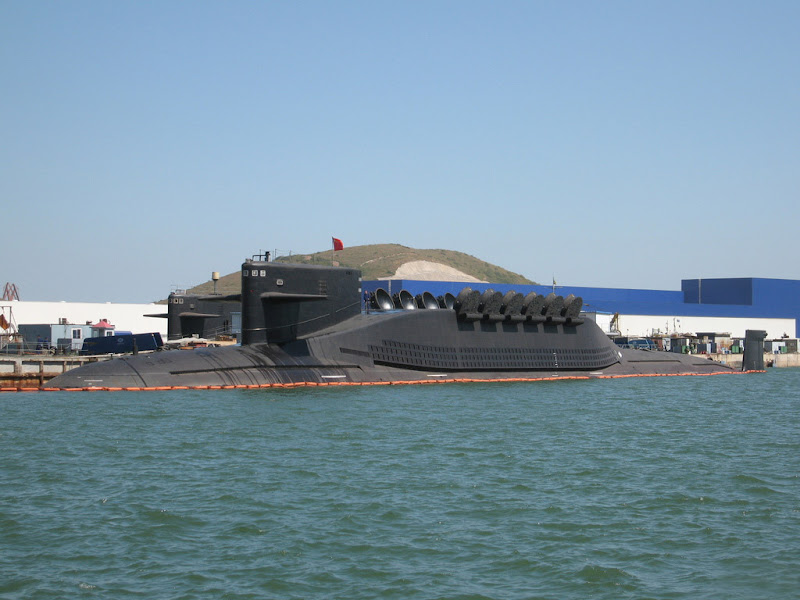
When Chinese President Hu Jintao was delivering his report on 17th CPC National Congress, he was unimaginable that at the same time an extremely close shot of China's New Ballistic Nuclear Submarine was being shared in Internet.
Not a satellite image, the clearest picture of this new submarine is found from an online college photo album of Tsing-hua University and was photographed on September 7, 2007. The location is probably the submarine manufacturing base in Dalian HuluDao shipyard, Liaoning Province.
In the images, 2 nuclear Subs can be found. The front one is a Type 092 similar Submarine, but some exterior features differentiate it from previous model.
Firstly, the Sub's sail has some tiny differences with the well-known No.406 "Xia" SSBN, including the diving wing position and observing window. Secondly, this sub has a bulged tip of the tail fin, which perhaps plays as a long-wave communication device for receiving commanding code. Third, the array of drainage on the missile launch compartment is modified.
The rear one has no details but its sail displayed on the image, it can be primarily judged to be the same one with the front.
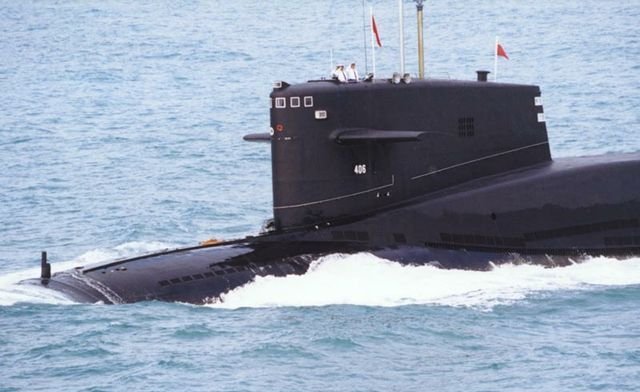
Type 092
Besides, the lids of 12 SLBM launch tubes of the submarine have been swung open. The inner side of tube cover is looks more hollow than before and it can be reasoned out that Chinese SLBM has less launching impact and better tube-space-saving after using “self-rupturing convex membrane” technologies, which learned from Trident C4 SLBM.

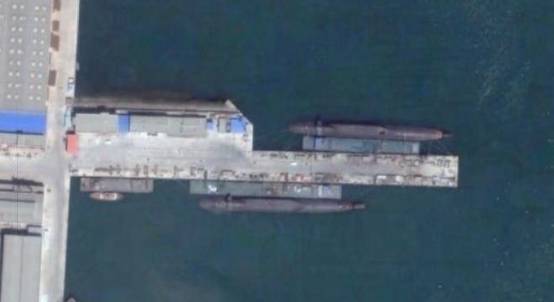
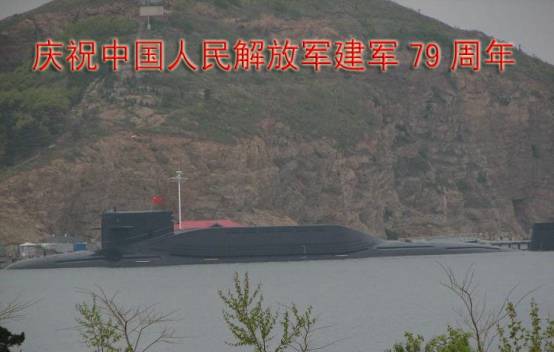
The exact model of these two SSBN can not be confirmed, but these two subs are the main roles which were discovered on Google Earth in October 2007 and discussed in western strategic analyzers. Actually, one photo of new Chinese SSBN has been unleashed in the year of 2006, but it can not be identified from previous type 092 model.
Chinese resources have different voices about this new model, some believed that they are new Type 094 Ballistic Submarine and dissenters insisted that they are just the modified model of Type 092. The exact model or type of these two submarines is nor important. But one truth is clear that China has at least held 3 SSBNs to carry 36 JL-2 Missiles. Under the estimation of 3 MIRVs of JL-2, PLA has really established a basic naval-based nuclear deterrence of over 100 nuke warheads.
Since 80th anniversary of PLA, some PLA's key naval underwater combat systems has emerged to public, including so-called "Type 093 and Type 094" submarines, which have been esteemed as powerful “Sha-Shou-jian” weapon by western countries. But the fact is that these new systems have no distinct advancement: Type 093 still in 1970s level and Type 094 (if it is) remain 12 SLBMs and inherit an outdated design in missile compartment.
Those indicated that China top heads are eager to establish reliable nuclear forces under U.S. pressure and have no patience to wait for low-efficiency state-run military industries providing world-class fighting systems. The negative influence of great degeneracy in 1970s "cultural Revolution" and "Economic Development First" Policy in early 1990 still exist in China military industries.
On his report on 17th CPC national congress, President Hu Jintao said that "China will enhance our capacity for independent innovation in R&D of weapons and equipment with better quality and cost-effectiveness" His words mean that after 20 years’ reform China has determined to erase its weapon systems’ disrepute of “Poor Quality”, “low additional value” and “Pirate Copy”.

August 29 (Wednesday), PLA's one new Hospital Ship was launched in Guangzhou. PLA navy listed this ship as "Type 920" hospital ship. This vessel was launched in the ship yard of CSIC (Guangzhou Shipyard International Company Limited), which is a subsidiary of CSSC (China State Shipbuilding Corporation).

Type 920 Hospital Ship has a transom stem, a bulbous bow, an extended deckhouse with a forward bridge. And a helicopter landing deck can be found on rear part of the vessel. Six Large Red-crosses have been painted on the ship body. The ship is approximately 170 meter length and 25 meter in beam and about 20000 tons displacement.
The model of Type 920 Hospital Ship was once displayed in Chinese Military Revolution Museum in Beijing for PLA's 80th anniversary. Resources said Type 920 hospital ship is a variant of Type 904 multi-product replenishment ship. This year early, China also bought a retired hospital ship from Russia, which will possibly be recovered as appropriative hospital ship.
Before the appearance of PLA's new hospital ship, PLA did not has any professional hospital ships in its fleets. Since the "Paracel Islands Conflict" in 1974 between China and South Vietnam navies, PLA navy notice the hospital ship's importance in modern naval warfare. But the economic ability makes that the building hospital ship converted by other boats is the first step.
In 1980, a cargo ship named "Qiongsha" was converted to a hospital ship and was renamed as Y833 "Nan Kang", which was provided to South Sea Fleet. Later PLA navy transferred two other ships to hospital ships, Y832 "Bei Kang" and Y834 "Dong Kang", and separately pointed to North Sea Fleet and East Sea Fleet. In 1990s, PLA South Sea Fleet also accepted a medical training ship “Nanyi 09” converted by a roll on/roll off ship.
Since CPC heads' call of "Strengthen the Military Preparation against Taiwan Island" in the end of 1990s, PLA navy enter a speedy development. Beside the combat ships, PLA navy also built auxiliary military ships. And hospital ship is the necessary equipment in amphibious invasion to Taiwan.
In 1996, PLA Navy Medical Research Institute successfully developed a "Ship-used Medical Module System". The system is based on international standard container and can quickly set up a fully-functional ship-borne hermetical medical system in civilian ships. According to China’s great power on ship-building, PLA will definitely get sufficient container ships to service as the supplementary to military hospital ship.

Type 920 Hospital ship is one part of PLA Navy’s “Marine Medical Ambulance System” concept. While PLA Navy is going to select some civil 150~500-ton class high performance passenger ships as medical ambulance boat, which transfer the wounded from the landing zone to the rear large hospital ships. Now Hi-speed SWATH, Sidewall Hovercraft and Air Cushion Catamaran are the options for PLA navy.
On September 19, "ZY-1"02B Satellite was successfully launched by CZ-4B Rocket from Taiyuan Launch Center. 10 days after, Chinese aeronautics experts show some interested information about the newest sino-brazil remote sensing satellite.
With ZY-1 No. 01 and 02 stars, 02B satellite's most noticeable improvement is a high-resolution CCD imaging camera, which has a 2.37 meter resolution on 778-kilometer high orbit. The image width is 27-km. Although the 2-meter level resolution is only available in black-and-white panchromatic images, it still can be reverted as false-color image under clients' demands.
From the mono-color 2-m resolution satellite image displayed by Chinese experts, people can clearly differentiate automobiles running on the highways, vessels on Yangtze River and airplanes on ground. Chinese experts even told that CRESDA (China Center for Resource Satellite Data and Applications)is going to be follow the lead of "GoogleEarth" to produce a country-scale image database and 3D Simulation map for Internet surfers' browsing.
Beside greatly improved image resolution, "ZY-1"02B satellite also has distinguished upgrade in positioning precision of ground objects. Previous "ZY-1"01 and "ZY-1"02's image has about 5-km warp to real world position and "ZY-1"02 has shrunk this error under 3-km level. But now "ZY-1"02B has technological breakthrough to realize 350-meter level. The main reason is that satellite is installed with a space-borne GPS receiver and star sensor。GPS can strictly locate exact position and orbit of satellite, then satellite star sensor can determine the star's posture to help project the picture on the right geometry position
Obviously, ZY-102B's excellent performance of hi-resolution imaging CCD camera and ground accurate position system bring a fairly meaning strategic value.
In Chinese experts' opinions, China's R&D of civilian remote sensing satellite is equal to France. And from this estimation, it can be extracted that Chinese military imaging satellite, such as recently launched "Yaogan-2" satellite, is about in 0.6-1 meter resolution level and compares with French's Helios 1B imaging satellite.
The production of ZY-102B totally incorporates 16 sub-systems, which are separately taken charge by China and Brazil. Now it has been known that China is responsible for observing device and satellite control, and Brazil for structure design and satellite-borne power system. The agreement of zy-103 and Zy-104 satellites has been affirmative in both countries’ governments. So far ZY-103 star has been assembly a sampler star for thermal control test and electrical measurement in Brazil. INPE (Instituto Nacional de Pesquisas Espaciais) has eagerly expressed its wish of continuous cooperation with China in ZY-1-05 and ZY-1-06 satellites in future.
Chinese Governmental Xinhua News Agency on September 22 announced that China will build a new Satellite launch center in Wenchang City, Hainan province. The Wenchang Launch center is China's 4th Rocket Launch center after Jiuquan Launch Center, Xichang Launch Center and Taiyuan Launch Center. Wenchang Launch center will be finished in China's "12th-five-year-plan" and to be in service in about 2012.
Although Wenchang Launch center is affirmative in Chinese central government and CPC Central military Commission, China still hold 3 main launch bases in future. Xichang Launch center will play back-up role in China's space power and be merged into Wenchang Launch Center, and main Staff and experts in Xichang will be transferred to Wenchang Center, which will replace Xichang to be the main commercial launching center. Obviously, Wenchang's Geographic advantages will certainly increase China's competence in global commercial launch market.
The exact location of Wenchang Launching Center is in Longlou and Dongjiao Counties of Wenchang city's east direction. In 2004, Hainan province once advised to establish new base in Changsi county, which is north-east of Wenchang city.
Xinhua News did not provide the precise location of Wenchang Center, but Chinese resources showed that the new launch center is on the east coast of Hainan Island, not expanded from a former missile test base, which is now often mistakenly cited and located in the heart of the Island.
One launching facility is called as "Launching Pad I 2k1" and located in the West Diyuan village (19°37'10.59"N 110°56'51.76"E), another one is "Launching Pad II 2k2" and in Wuhu Village(19°37'31.25"N 110°57'13.91"E). Just being a neighbor of Longlou county, Dongjiao's some villages will be moved to other places for constructing "Residence District for Staff and Experts"
The new Wenchang center will utilize its low latitude advantage to raise Chinese rocket's payload and then extend satellite's life for less orbit maneuver. Generally, Wenchang Center will primarily used to launch GTO satellite, polar orbit satellite, space station cell and deep-space exploration satellite. Since China's CZ-5 rocket will use recyclable engine for its first stage rocket, so Wenchang, which is near southern China Sea, is proper for CZ-5 family.
Now CZ-5 is still in development, and its 1,200 kN thrust LOX/kerosene engine in September just successfully passed its 78th full-engine hot-fire test. And the accumulated test time is up to 13500 seconds.
Besides, Chinese official media also indicate that its pre-developing Aerospace vehicle will initiate in Wenchang launch center.